South Windows, Upper Portion
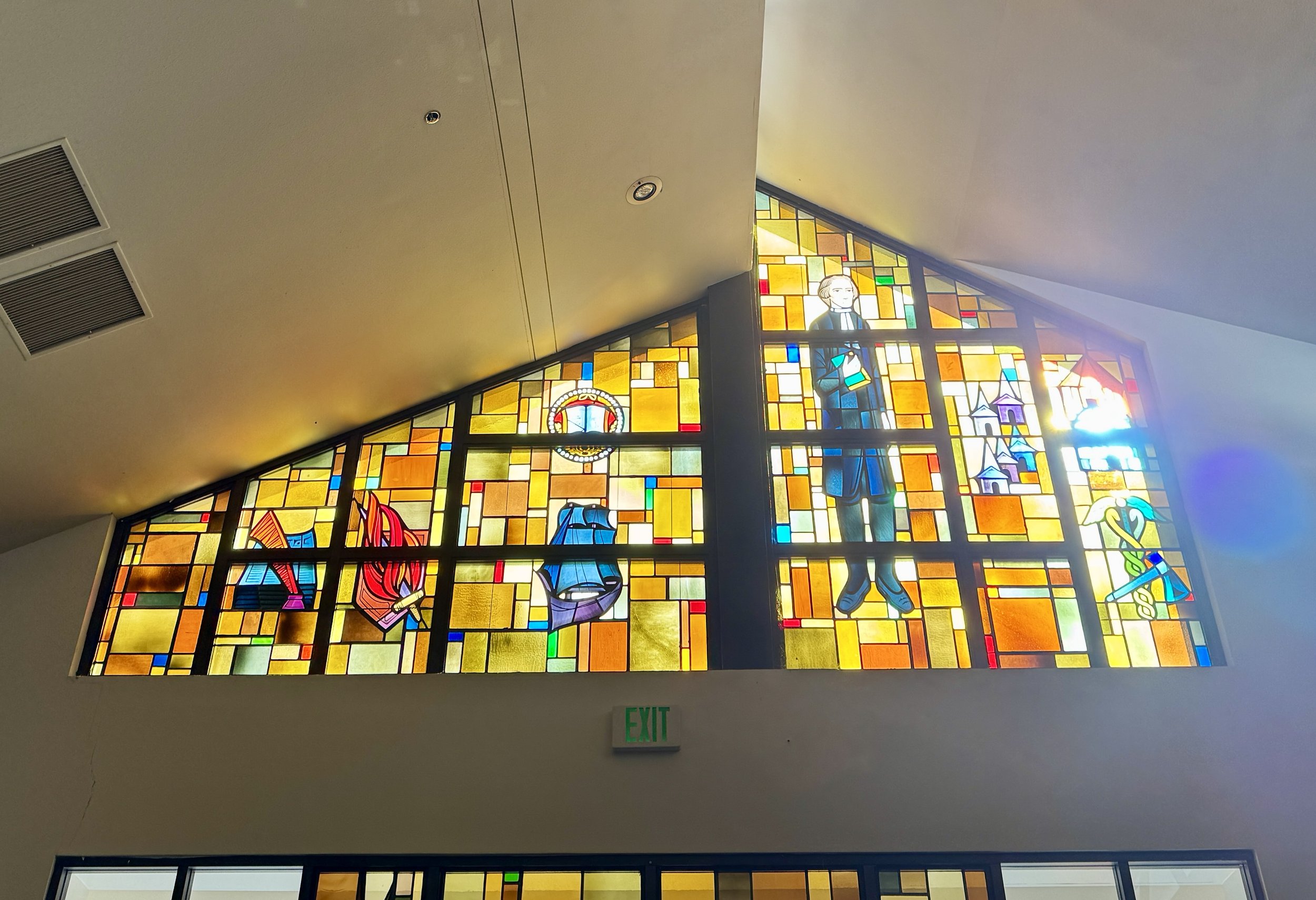
The upper portion of the South Windows, above the doors that lead to the Narthex and the patio.
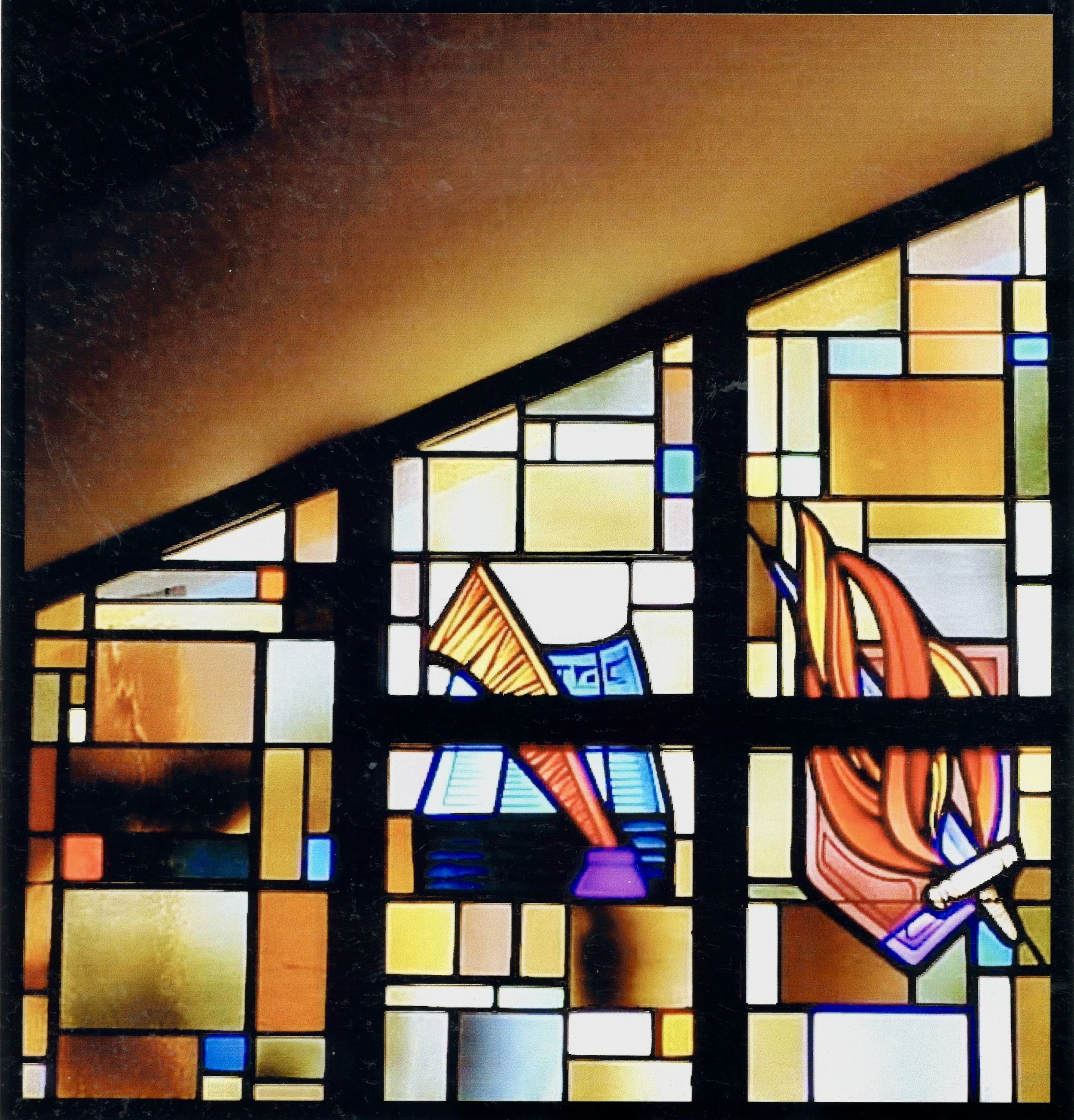
Detail, South Windows, Left Symbols.
Quill and Newpapers represent the dissemination of the Christian message. The Flaming Sword and Shield represent Christian victory over violence (what the Church is called to, even if we have many times perpetuated cycles of violence instead; cf. Isaiah 2:4, Matthew 26:52). The sword is often used to represent the many saints who have suffered martyrdom. It is also used by the author of Hebrews as an image to describe Scripture, which is “sharper than any two-edged sword, piercing until it divides soul from spirit, joints from marrow” (Hebrews 4:12). Paul, likewise, refers to “the sword of the Spirit, which is the word of God” (Ephesians 6:17). Fire and flames symbolize both religious fervor and martyrdom. The flames also call to mind the tongues of fire that came upon the gathered disciples at Pentecost (Acts 2:3).
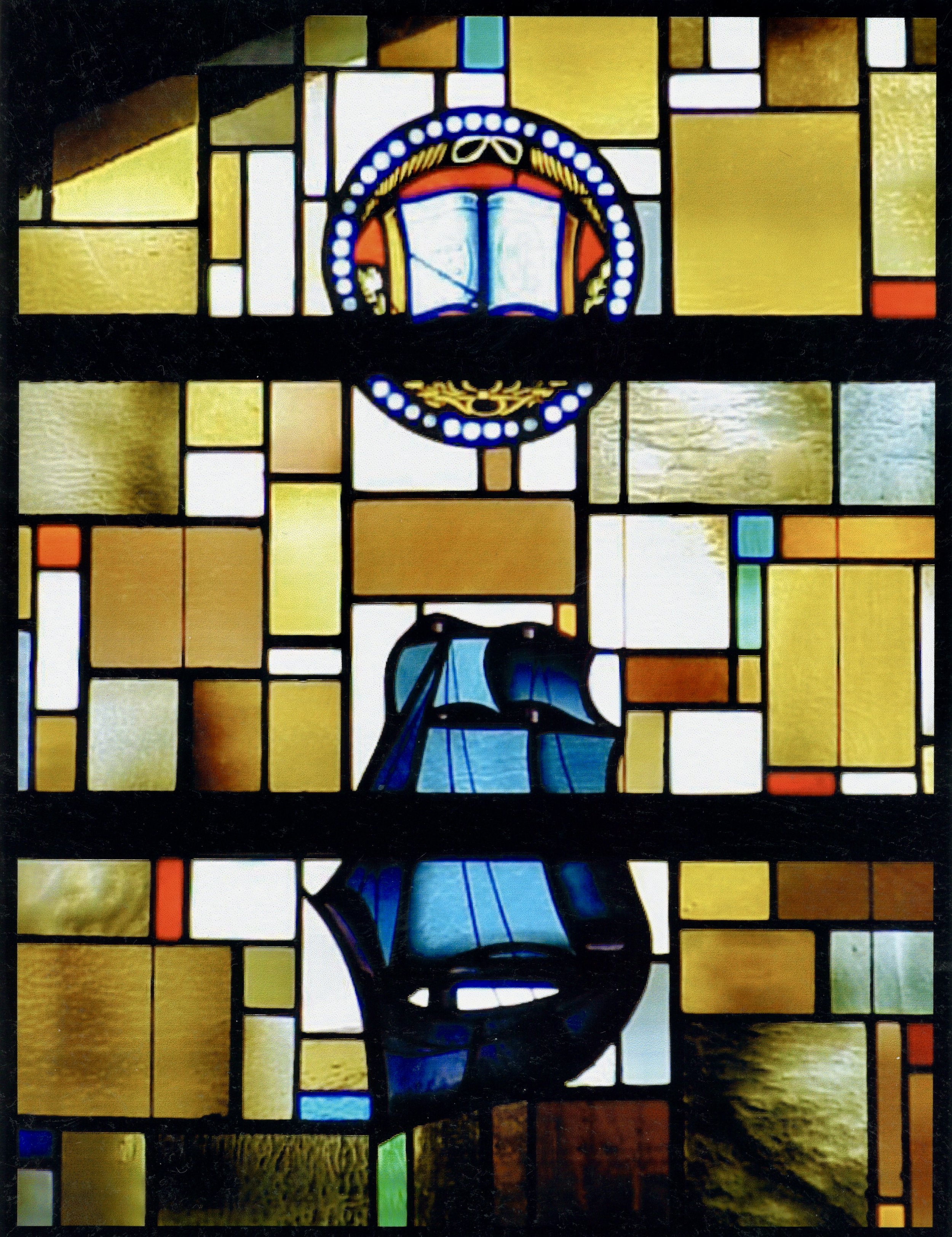
Detail, South Windows, Left Symbols.
The Seal of the Presbyterian Church in the USA as it looked when the glass was originally created.
The ship below is the Mayflower, which in 1620 transported the Pilgrims to the New World in search of religious freedom.
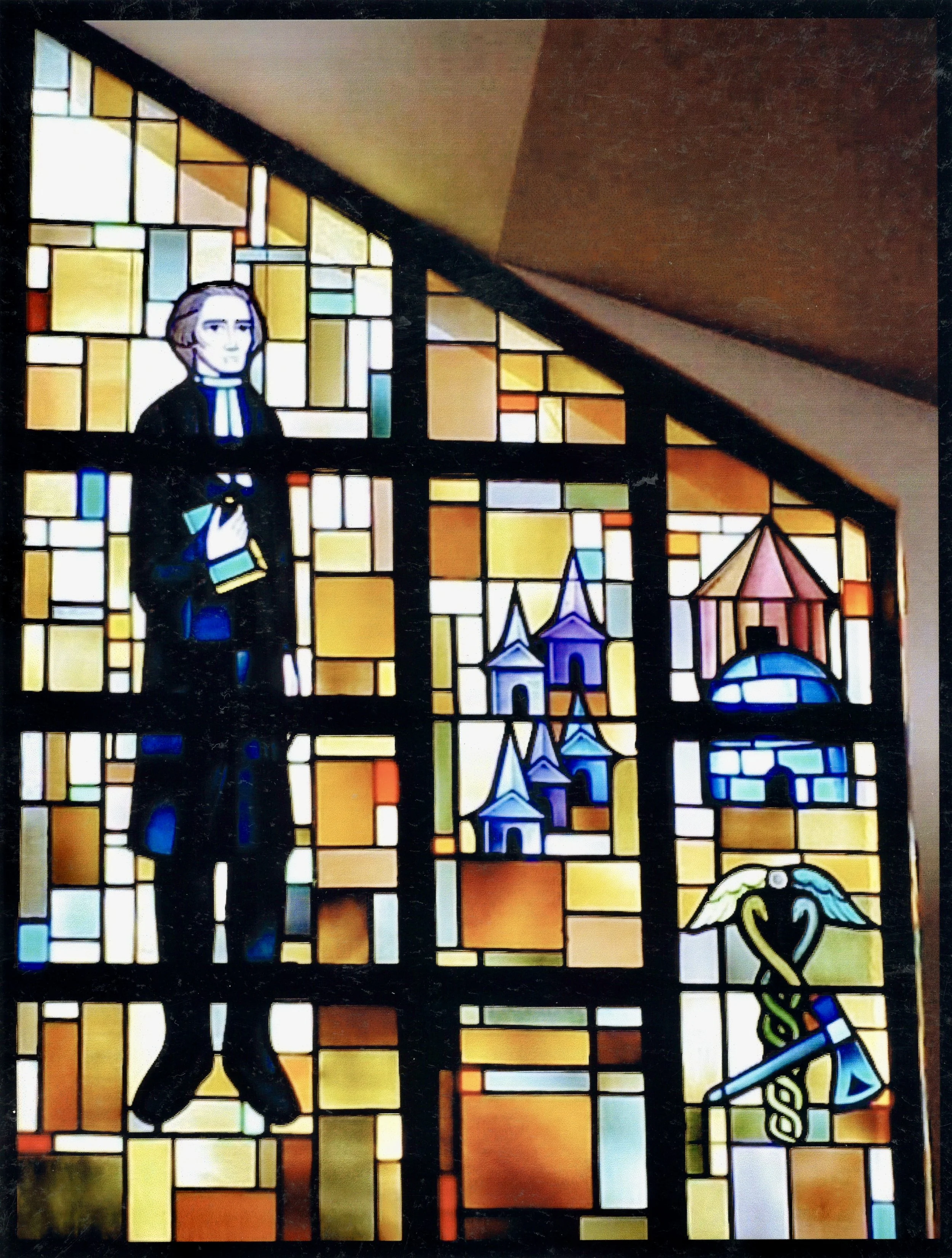
Detail, South Windows, Right Symbols.
Francis Makemie (the “Father of American Presbyterianism”) with Small Church Buildings, an Igloo and Hut, and a Caduceus and Tomahawk.
Francis Makemie is considered to be the founder of Presbyterianism in the United States. Makemie was Scots-Irish, born in Ireland in 1658, and he went to Maryland at 25 in response to a call for more trained preachers in the colonies. After a period of itinerant preaching he helped to organize five churches and, in 1706, became the moderator of the first American presbytery, in Philadelphia. The following year, he was arrested and put on trial (and ultimately acquitted) for preaching without a license in (officially Anglican) New York. Because of this ordeal, Makemie is also remembered as a champion of religious freedom.
The small church buildings represent the churches established by early Christian leaders in the New World. The image of igloo and hut represents missionary work. The igloo is a nod to Sheldon Jackson (1834-1909), a prominent Presbyterian missionary to Alaska (the igloo image was originally on a window depicting Jackson).
The caduceus and tomahawk represent Marcus Whitman, a Congregationalist missionary to the Pacific Northwest (and the namesake of Walla Walla’s Whitman College). The caduceus (a rod with two serpents, with the name coming from the Greek for “herald’s wand”) is associated with the Greek god Hermes (notice the wings at the top), and is the symbol of commerce. It is commonly confused (as in our window) with the Rod of Asclepius, which is a symbol for medicine (Whitman was trained as a physician).
The tomahawk was used by the Native American nations as both a tool and a weapon. Whitman and his wife were killed by a tomahawk (as part of the “Whitman Massacre”), when they were blamed for an outbreak of measles that was introduced by white settlers and which killed hundreds of the native Cayuse peoples.